Thursday, March 8, 2012

How Critically Do You Read?

A great post from the YA Highway Blog. Happy reading!

How Critically Do You Read?: There are tons of different types of readers, no doubt. Examples range from people who only read books that they seek out while browsing in the store or library, to the ones who can't help but snag as many ARCs/new releases as possible and just jump in with both feet, to everything in between and beyond.

There are also many different levels of how critically each individual person will read their chosen books. Do you like just about everything you read? Do you only like most of it? Do you hardly ever enjoy yourself?


The thing I'm curious about today is....can how critically we read these books affect our writing, either negatively or positively?


I often wonder if it's possible to become so caught up in critical discussions and reading methods that you end up shying away from certain elements in your own writing that you otherwise would have dived right into, causing you to seriously hold back. A couple of writer friends mentioned to me the other day that they really feel like they can tell if the author truly enjoyed herself/himself while writing the particular book.


That passion can really add a magical "it factor" touch to any story. But if you're afraid to dive into certain elements because you know in the back of your head that the YA community is currently analyzing it into oblivion, some of that magic could become smothered.


On the other hand, being fully and completely aware of what layers make up a novel, and which types make you weary, frustrated, or annoyed with the author, can help you avoid making the same mistake on your own WIP. You can use the way you read critically to improve yourself, and books naturally sort of become a mass studying session with a story on the side as opposed to the other way around. Avoiding certain pit falls that routinely gain criticism, from certain types of characters to overdone settings or premises, can really give you a sense of relief and confidence to finish whatever you're working on.


I'm sure this varies from person to person, depending on personal life factors or philosophies that will strongly negate how you feel about certain books, as well as your general experience while reading them.


I'd love to see what you guys have to say on this. Do you think in-depth critical reading is valuable? Do you think it holds you back in any way, good or bad? Is it even something you can control at all?

Thursday, February 23, 2012

Academics Now

Right now things are bad.

Its a really bad time to go back to school, which also means its a bad time to be in school. Why? Because that's where everyone is right now. Currently we are flooded, for lack of a better word. Schools are overwhelmed with applicants, and students alike. There are just too many of us, and universities have become degree factories. What does that mean? Well if everyone has a degree, it means yours isn't very special.

The same holds true for graduate school applications. This year, more than others, the amount of applications has been overwhelming. Schools are swamped with so many applicants all hoping to get into a grad program. It doesn't even matter what grad program you're applying too. Everyone I know hasn't gotten in, and these aren't your slacker, average students. But when a grad program with 6 openings gets 200 applications things fall through the cracks. Not to mention the fact that they only have 6 slots because they don't have any money either.

I'm just glad that I wasn't applying this round. But is the next round going to be any better? Will my program be flooded with applications from those returning to their education because their job let them go. What does that mean for me? I, who haven't even had a chance at a career, losing out to someone who has lived half their life and are now going back for a second try.

That means I have to be more competitive than I previously realized. I need to be published, I need to give talks, I need to do all the things that graduate students do, but I need to do them as an undergrad. Good luck.

Saturday, February 11, 2012

Update

The blog is changing, sort of.

I in fact do other things besides archaeology, and some of them are interesting too.

Its still going to be about archaeology (because well, I am an archaeologist), but it will not longer be solely about archaeology. Though I hope to go on another dig this summer, and bring many more adventures in archaeology to you. I didn't want to start another blog just to talk about other aspects of my life. Plus I kinda need to fill the downtime for when I'm not on a dig, or if not much is going on at the museum. Which does happen.

Maybe I'm being lazy, be I don't really want to start another blog, I've already got two. That seems like enough, especially when I don't have much time for either of them. But occasionally I do want to talk about things that don't fit on the writing blog or the archaeology blog. So things will change here, but not too much. Now it will just encompass all of my adventures.

Monday, December 5, 2011

Finals are Hell

And its not even finals week. What the hell? Finals week starts next week, it hasn't even been dead day yet. You know, the day where I'm supposed to kill myself studying. And yet I have a final tomorrow. Okay, not a final, because finals are not allowed on the last day of classes according to university policy. So instead we're having an exam, not a final, notice the difference (the spelling). So if you call your final an exam and tell the class that you are not having a final (as in no test on the scheduled final day) you can totally get away with having finals on the last day of class like a jerk. Way to subvert the system.

This wouldn't be so terrible if I didn't have a 3000 work paper due the same day, or the 8 page paper due before that, or the other 3 finals that I have. I suppose I have a total case of senioritis, and still a year left to go. All I really want to do is  work on my own projects. The independent study for next year on the aryballos I have been complaining about is morphing into a monster that I have yet to tell my professor about. I'm not sure how I'm going to break it to her, or what that's going to mean...

In the mean time here's some pictures of stuff in the old world cabinet at the museum. Eventually I'm going to go through it to make sure we're not missing anything, but not right now. Currently a whole lot of other things need to be reorganized, or more correctly put in their proper places. That's going to take awhile, and with school going the way it has been it doesn't leave much time for volunteering, probably less next term. We'll see.


Thursday, November 3, 2011

Archaeology in the Library

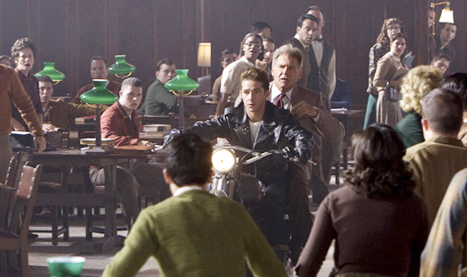
Yeah, I know this isn't one of the better Indiana Jones movies. In fact its probably ranked below Temple of Doom. But there are some great one liners, and in this scene has a very important one. A student is asking Doctor Jones about some reading to which he does give a better reference to the student and then declares, "If you want to be an archaeologist, you have to get out of the library!"

While that is true, a great deal of your time will also be spent in the library. You need to look up old excavation reports, look for similar pieces, and histories of the sites you are studying. If you're lucky you find more recent publications, mostly from the eighties some nineties, but these are rare. You'll find a whole lot from the fifties and sixties, and even forties and thirties. Not that these aren't helpful, and don't provide a wealth of information, but what you have to remember is that archaeology was very different back then. The sixties not so much, but if we look back to Doctor Jones here, he is a very different kind of archaeologist.

The term that would better suit Dr. Jones is antiquarian. Antiquarianism is a step above treasure hunting, but not by much. You won't see Indiana Jones with pot sherds. No, he's after the good stuff. Gold, precious stones, the ark of the covenant. In its very early years archaeology was the hobby for the bored and rich. If you had the money you would fund excavations and even go on them yourself. Lots of sites, artifacts, and tombs are named for their rich discoverers (the Elgin marbles, tomb of the baron, etc). As a result we have plenty of excavated sites, but little information on them as the only interest was in the 'treasures' they held. So when looking at these older publications you need to remember what kind of archaeology was being practiced. What were the excavators interested in, and what might they have ignored because of the time they were practicing in.

These old books can be helpful in understanding sites, but I can only imagine what else has been left out, determined to be unimportant back then. Things that are a mere side note, that we will never see again, and who knows what information it could have yielded if only it had been set aside for a time when we had the understanding and technology to look at it.

Tuesday, October 25, 2011

An Awful Lot of Trouble

So here is the aryballos I'm working with at the Arizona State Museum. It got fancy pictures taken.


My original thought is that it is a late Proto-Corinthian aryballos dated to about 650-630 BCE. Much like this late Proto-Corinthian aryballos.


Note the similar shape, and the scale pattern. Also if you were to turn it slightly, to see the handle, you would see vertical stripes on both.

But wait... What is this?


And this one?


Both of these also bear striking resemblances to my piece at the museum. The first is classified as Etrusco-Corinthian and the second as Italo-Corinthian. And what does this mean for my piece? Is is still Proto-Corinthian? What is Etrusco-Corinthian and Italo-Corinthian?

Etrusco-Corinthian pottery is pottery that resembles and was inspired by Corinthian pottery, but was made in Etruria, possibly by Etruscans.
This is the same for Italo-Corinthian, except its Italy, not just Etruria, which is a part of Italy (if you didn't know).

This means that I have no idea what to call my piece, other than an aryballos, because it is unmistakably that shape. I have a lot more work to do. Luckily I'll be doing an independent study on it, so I'll be getting some credit for it. I also have a meeting tomorrow with yet another archaeologist who specializes in Italy. So more news to follow. Until then, this little mystery is driving me crazy.

Sunday, October 2, 2011

Aryballos Update

So this little thing is gonna help me get into grad school.
Why?
Because it is an unpublished and excellent example of Corinthian pottery.
The key word here is unpublished. As in no one has ever written about this particular piece. Mostly because its been languishing away in a store room of a museum that specializes in South Western artifacts. But nonetheless, that fact makes it interesting. Donated back in the 1900s, mislabeled because of where it came from, this piece has an interesting history. What is most interesting is that it is labeled as coming from Pompeii, which I suspect is why they decided it was Roman.
Even more interesting is that it really could have come from Pompeii, just not Roman Pompeii. Pompeii is not just a Roman city, it has a much longer history than that. Before the Romans the Etruscans decided it was also a great place to be. And very interesting about the Etruscans was that they really liked these little Corinthian aryballoi (plural for aryballos). Could this little piece have found its way through trade?
So back to how this is going to help me get into grad school.
Well, I'm not the only one who finds this piece interesting. Since I'm working on relabeling it, I've been consulting with my Greek archaeology professor. She thinks its a great project, and that it would make a great paper. In fact, she's wanting me to publish on it. And a publishing credit on a grad school application, makes me highly desirable. Because its rare. Its just not something that undergrads usually do, frankly we're too busy with regular school to work on side projects. Its possible that I can do an independent study, but I think by the time that rolls around I'll have done most of the work already. So there you go, volunteering can pay off.